What are dental implants?
Dental implants are titanium or ceramic posts that are inserted into your jawbone to hold artificial teeth. They act like the roots of your natural teeth to provide a strong foundation for fixed (permanent) or removable replacement teeth that are made to match your natural teeth.
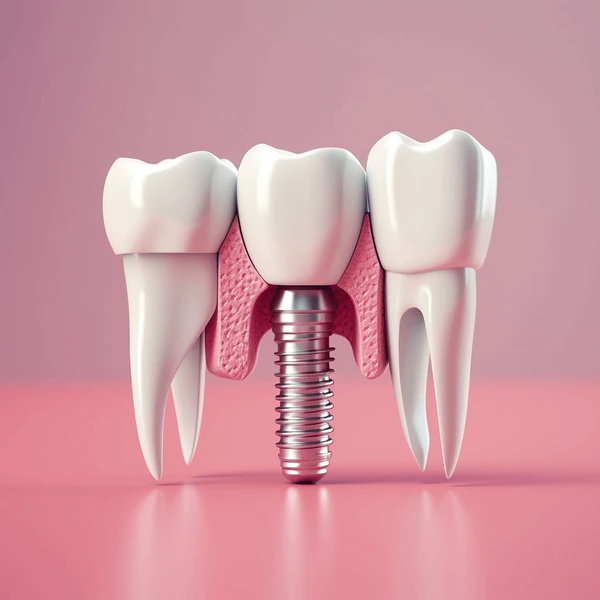
In addition to filling in gaps in your smile, dental implants improve chewing function and overall oral health. Once healed, implants work much like natural teeth.
Missing teeth can take a toll on your oral health. But it also impacts your mental and emotional well-being. Do you avoid social situations? Or cover your mouth when you laugh? Do you rarely smile for photos? Dental implants can restore your smile and your confidence, so you don’t have to miss out on the things you enjoy.
What conditions are treated with dental implants?
Dental implants treat tooth loss, which can happen due to:
- Cavities.
- Cracked teeth.
- Gum disease.
- Teeth that never develop (anodontia).
- Teeth grinding or clenching (bruxism), etc.
What are the Categories of dental implants?
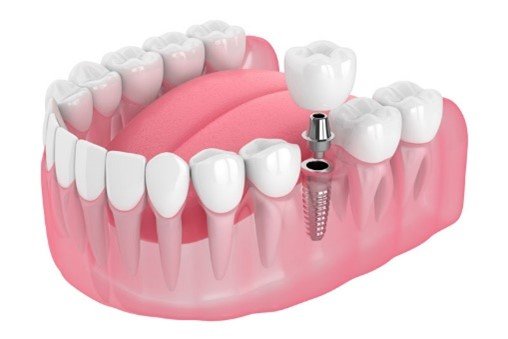
1. Single tooth implants– Are you only missing one tooth? Then an individual dental implant and crown will be all that you need. The implant sets immediately next to your other teeth, preventing any alteration to their structure. In fact, the implant can add support to help you maintain natural tooth alignment.
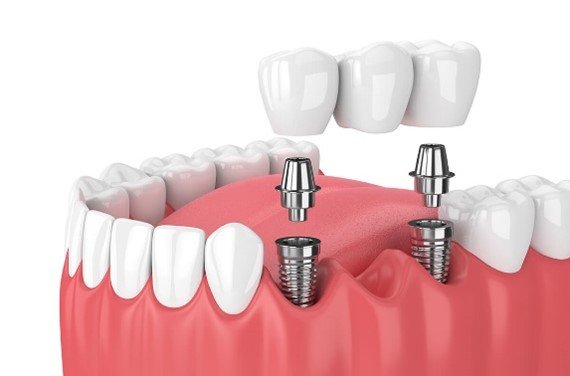
2. Dental implant bridges– Let’s say you’re missing a few teeth in a row. In a conventional scenario, you might be looking at wearing a removable partial denture. When there are 3-4 missing teeth, it’s just not possible to affix a traditional bridge onto the remaining teeth on either side. However, it is possible to use a pair of implants at each side of the gap to permanently anchor a multi-tooth implant bridge.
3. Implant supported dentures– Maybe you just want to go “old school” and get traditional dentures. That’s perfectly fine! The issue with dentures is that they rely on a strong seal underneath the “plate” of your denture and against your gum tissues. If you have thin bone, it may cause the denture to feel loose or rock around throughout the day. This scenario can lead to additional bone loss, sore spots, and difficulty doing normal things like eating or talking. To prevent that, we can affix small locators on the under-side of your new denture and a corresponding dental implant at that site inside of your mouth.
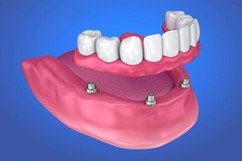
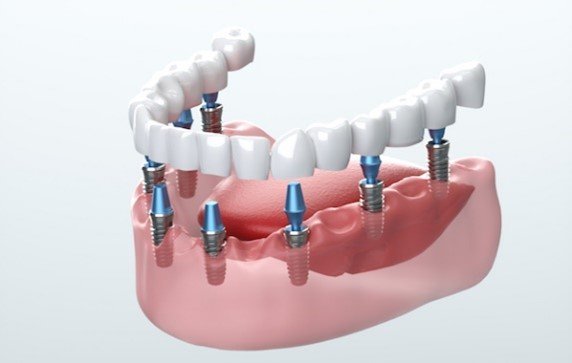
4. Completely edentulous arch– When you need to replace all of your teeth at once, and you want a permanent solution — All-on-4/All-on-6/All-on-8 implants are probably the most popular choice. In this procedures, the dental specialists strategically places implants to support a slim, streamlined device that follows the contour of your mouth. It’s like a denture and a dental bridge hybrid. There’s no “plate” over the roof of your mouth.
Procedure Details
What is the process of getting a dental implant?
Dental implant surgery is a personalized process. It’s not the same for everyone. But the following gives a general overview of what you can expect your dentist to do:
- Place the implant surgically.
- Give you time to heal.
- Attach the post and final crown, bridge or denture.
Dental implant surgery
During dental implant surgery, your surgeon will:
- Give you anesthesia: This medication will numb your gums. If you choose sedation, your provider will give you those medications, as well.
- Create an incision: Your surgeon will make an incision (cut) in your gums. This exposes the bone underneath so your surgeon can place the implant.
- Prepare your jaw: Your surgeon will use a series of specialized instruments to create a small hole in your jawbone. They’ll widen the opening until it’s just the right size for your new dental implant.
- Place the dental implant. Next, your surgeon will carefully place the dental implant into your jaw.
- Close the incisions. Finally, your surgeon will reposition your gums and close the incision with stitches.
If your implant is near the front of your mouth, your dentist will make a temporary tooth for you to wear until you heal. That way, you won’t have a gap in your smile while you recover. If your implant is near the back of your mouth, you probably won’t need a temporary tooth. Your provider can tell you what to expect in your situation.
Healing phase (osseointegration)
During the healing phase, your jawbone should fuse to the dental implant. This process, called osseointegration, is critical for stability and long-term success. This process can take anywhere from three to nine months. In some cases, it may take longer. It depends on how quickly your body heals.
Placement of abutment and final restoration
Once your implant heals, your dentist can attach the abutment (small connector post) and your final restoration (crown, bridge or denture). This usually takes about one hour to complete and may require a second minor surgery.
How painful is getting a dental implant?
You shouldn’t feel any pain during your dental implant procedure because your provider will use medication to numb your gums. After your surgery, it’s normal to have slight discomfort and swelling. Over-the-counter (OTC) pain killers can help ease these symptoms.
Risks / Benefits
What are the benefits of dental implants?
Tooth loss changes the way you eat, speak and connect with the world around you. Dental implants are the closest thing to natural teeth and offer benefits like:
- Better chewing ability.
- Enhanced smile.
- Improved speech and enunciation.
- Jawbone preservation.
- Longevity. (Dental implants can last a lifetime with proper hygiene and regular dental visits.)
- Stability for wobbly dentures.
Another advantage is that dental implants don’t require enamel removal like bridges do. To replace one missing tooth with a dental bridge, your dentist must alter (shave down) at least one tooth on either side of the gap. This can weaken your natural tooth structure over time.
A dental implant replaces your missing tooth without involving the neighboring teeth. It’s a one-tooth solution to a one-tooth problem.
What are the risks or complications of dental implants?
It’s normal to have slight bleeding and swelling after getting your implant. But like any procedure, dental implant surgery carries the possible risk of complications.
Complications are uncommon, but may include:
- Damage to nearby teeth.
- Delayed jawbone healing.
- Infection.
- Jaw fractures.
- Nerve damage.
- Severe bleeding.
- Sinus damage.
Recovery and Outlook
How long does it take to recover after dental implants?
Initial healing takes about one week. But it takes anywhere from three to nine months for your jawbone to fuse around the implant (a process called osseointegration). This process stabilizes your implant so you can use it just like a natural tooth.
Your provider will check on your progress every few weeks. Once the implant heals, it’s safe to add the restoration (crown, bridge or denture).
How long do dental implants last?
Dental implants last longer than alternative treatments (like bridges and dentures). With brushing, flossing and regular dental visits, implants can last a lifetime.
The restoration part of your dental implant will need replacing at some point. Most crowns and bridges last around 15 years and most dentures last at least seven years, but this timeline varies.
When To Call the Doctor
When should I call my dentist?
If you have a dental implant, call your dentist any time you notice:
- A loose or wobbly implant.
- Bleeding gums.
- Pus (infection) around the implant.
- Swollen gums.
- Swollen lymph nodes in your neck (occurring along with one or more of the above symptoms).
Additional Common Questions
At what age should you not consider dental implants?
The minimum age for dental implants is typically 18, and there’s no upper limit. The main requirement is that you have enough healthy bone in your jaw. Your dentist is the only person who can tell you whether you’re a candidate.
Who shouldn’t get dental implants?
Dental implants might not be the best option if you:
- Are under the age of 18. (Most surgeons won’t place dental implants until your jaw stops growing.)
- Smoke or vape.
Or if you have:
- Active or untreated gum disease.
- Certain health conditions (like bone disorders and some autoimmune diseases).
- Extensive tooth decay.
- Poor oral hygiene.
- Severe bone loss in your jaw.
Every person has a unique health history. To find out for sure if you qualify for dental implants, talk to your dentist.